

Managing a residential property portfolio requires a strict commitment to tenant safety. Following recent overhauls in UK housing legislation, fire safety compliance has become a primary focus for local authorities and private property owners alike. Ensuring your properties are fitted with legally compliant entry systems is no longer just a recommendation; it is a critical statutory requirement.
At Shelforce, we are proud to be supported by Birmingham City Council as one of their trade manufacturers and suppliers of choice for windows and doors. Our trade products deliver everything from thermal energy efficiency to robust security. By understanding the rigorous standards framework surrounding new doors, landlords can protect both their tenants and their investments.
The changing landscape of UK fire door legislation
The regulatory framework underwent a massive shift in recent years to address structural vulnerabilities highlighted by the Grenfell Tower Inquiry. The Fire Safety Act clarified that the structural envelope of a building, specifically including individual flat entrance doors separating domestic premises from communal spaces, falls entirely under the scope of the Regulatory Reform (Fire Safety) Order 2005. When selecting materials for new interior doors, options like solid core timber, and fire-rated composite materials are highly recommended for their durability, acoustic performance, and enhanced fire safety. These materials not only comply with updated regulations but also provide extra peace of mind for both safety and building longevity.
As of recent regulatory updates, these rules enforce specific mandatory inspections and performance criteria based on building height. The legislation ensures that every fire door acts as a reliable barrier to smoke and flame, creating safe evacuation routes for residents and predictable environments for fire services.
What the legal changes mean for housing providers
For landlords, the regulations remove any ambiguity regarding who is responsible for door safety. If your residential building contains two or more sets of domestic premises, you are legally classed as the ‘Responsible Person‘.
This designation means you must ensure that all entrance doors and internal doors along escape routes meet strict fire-resistance standards. Furthermore, landlords are legally mandated to provide residents with clear, accessible information regarding the importance of keeping fire doors closed, reporting faults immediately, and ensuring that self-closing mechanisms are never tampered with.
Fire resistance ratings explained
When specifying new doors for a multi-occupancy property, understanding fire ratings is critical. Standard domestic interior doors or thin hollow core options do not provide adequate protection. Instead, compliance requires a certified fire door with a solid core construction.
- FD30: This is the standard specification for most flat entrances and internal corridor doors. It guarantees a minimum of 30 minutes of fire resistance.
- FD60: Typically specified for high-rise settings, deeper lobbies, or high-risk areas, providing 60 minutes of resistance.
These doors rely on specialised intumescent strips and smoke seals embedded into the frame or door edge. When exposed to heat, these strips expand to seal the gaps around the door, blocking toxic gases and preventing capillary-like smoke travel into communal zones.
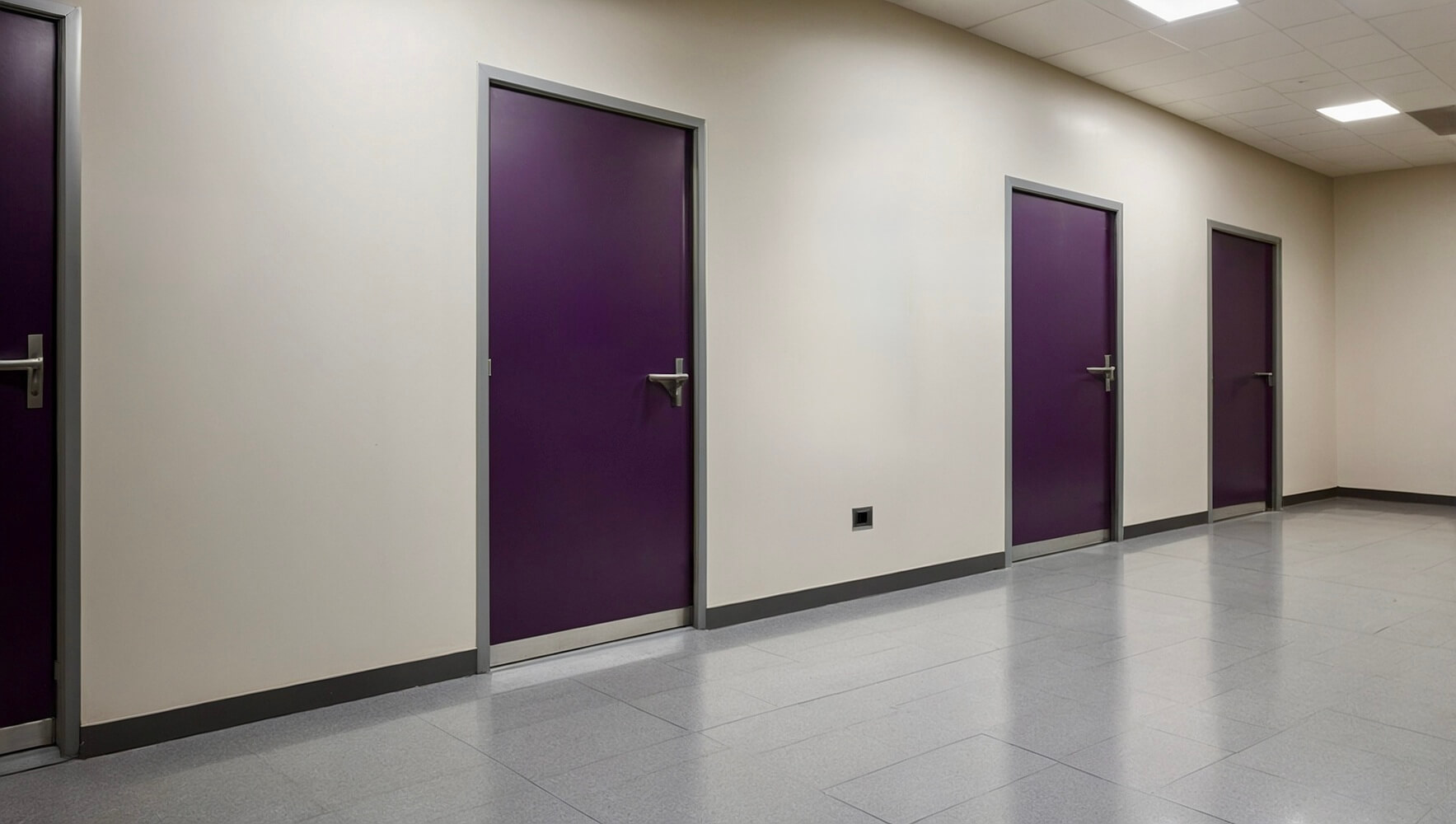
Fire-rated school doors in a UK corridor, ensuring safety and compliance with UK fire regulations.
Your ongoing inspection and maintenance duties
Compliance is not a one-time event completed when new doors are hung. Wear and tear in high-traffic residential blocks can rapidly degrade a door’s performance. Under current guidelines, the mandatory checking schedule includes:
- Every 3 Months: Responsible persons must check all fire doors in communal areas, including corridors, plant rooms, and service risers.
- Every 12 Months: Landlords must use best endeavours to carry out an annual inspection on all flat entrance doors.
During these checks, you must ensure the self-closing device fully shuts the door unassisted from any angle, verify that the intumescent seals are undamaged, and confirm the structural integrity of the frame.
The severe cost of non-compliance
Ignoring fire door regulations carries devastating consequences. Beyond the immediate risk to tenants, local fire and rescue authorities possess the power to issue enforcement notices, prohibition orders, and substantial financial penalties.
In severe cases of negligence, non-compliance leads to criminal prosecution and imprisonment for landlords. Additionally, standard commercial property insurance policies are frequently invalidated if an investigation reveals that uncertified, non-compliant hollow core doors or improper alterations contributed to the spread of a fire.
How Shelforce supports landlords with certified solutions
Navigating these strict housing standards requires a manufacturing partner you can trust. Shelforce delivers high-quality, fully compliant door styles designed specifically to meet the rigorous demands of local authorities and private landlords across the Midlands.
Our solid core doors provide the ultimate combination of certified fire protection, high security, and aesthetic variety. Whether you are replacing flat entrances, updating communal fire doors, or outfitting modern homes and home offices, we eliminate the guesswork from compliance. We control the manufacturing process from start to finish, ensuring every product matches exact British testing standards. Our fire doors also come in various materials and finishes to suit interior décor while meeting safety and regulatory requirements.
Get in touch with the Shelforce team today to discuss your property portfolio, request compliance documentation, or obtain a quote for your project:
- Contact Form: Shelforce Contact Page
- Phone: 0121 603 5262
- Email: shelforcesales@birmingham.gov.uk


 >
>